
People often see GMFU in text messages, social media replies, memes, and comment sections. It shows up when someone has a strong reaction to what they just read or heard. Across current public sources, the most common meaning is “got me fucked up,” and it is used as internet slang, not formal English.
This matters because the phrase is strong, emotional, and rude. A reader may misunderstand it if they only know standard English. In this guide, you will learn what GMFU means, how people use it, when it fits, when it does not, and how to replace it with cleaner wording when needed.
Quick Answer
GMFU meaning in text is usually “got me fucked up.” It is a slang reaction people use when something feels shocking, frustrating, disrespectful, unfair, or hard to believe.
TL;DR
• GMFU usually means “got me fucked up.”
• It is informal and contains profanity.
• People use it for shock, anger, or disbelief.
• It works best in casual chats.
• It is not a good choice for school or work.
• Softer replacements exist for polite situations.
What Does GMFU Mean?
GMFU stands for “got me fucked up.” That is the meaning most consistently shown in live public sources.
In plain use, it means something has thrown you off emotionally. You may feel irritated, shocked, offended, or confused. Sometimes it can also mean, “You have the wrong idea,” or, “This situation is way out of line.”
Definition in Plain English
A simple way to understand GMFU is this: it is a strong reaction phrase. People use it when something feels so wrong, so surprising, or so annoying that they want to show immediate emotion.
Here is the plain-English idea:
• “That really shocked me.”
• “That upset me.”
• “That made no sense.”
• “That crossed a line.”
Those are softer ways to explain the feeling behind GMFU. They are not exact matches in tone, but they help beginners understand it.
Is GMFU a Word, Phrase, or Part of Speech?
GMFU is best understood as an acronym for a phrase. It is not a standard dictionary word in formal English. It comes from a longer spoken expression and is used mostly in digital slang.
In real messages, it often works like a reaction phrase or a complete response.
Examples:
• “You canceled again? GMFU.”
• “Nah, that story got me GMFU.”
• “They raised the price again. GMFU.”
So, in practice, people treat it more like a casual reaction than a fixed part of speech such as a noun or adjective.
How People Use GMFU in Texts and Online
GMFU is common in fast, emotional conversations. You may see it in:
• text messages
• group chats
• TikTok comments
• Instagram replies
• meme captions
• gaming chats
• casual posts on X or other social platforms
People usually type it when they want a short, sharp reaction. It saves time and keeps the emotional punch of the full phrase.
Common Contexts for GMFU
The exact feeling depends on context. That is why the same acronym can sound angry in one message and playful in another.
Most common uses include:
• Disbelief: “You paid that much for shoes? GMFU.”
• Frustration: “They moved the deadline again. GMFU.”
• Feeling disrespected: “After all that, he ignored me. GMFU.”
• Confused shock: “Wait, they fired her today? GMFU.”
• Playful exaggeration: “You ate my fries again? GMFU lol.”
A common mistake is to think GMFU always means rage. It does not. It often signals strong emotion, but that emotion can range from annoyance to surprise to sarcastic humor.
When to Use GMFU
Use GMFU only when the setting is casual and the people involved will understand the tone. It works best with friends, peers, or online spaces where slang is normal.
It can fit when:
• you are reacting to something shocking
• you want to sound blunt and emotional
• the chat is informal
• the audience is comfortable with profanity
When Not to Use GMFU
Do not use GMFU in professional, academic, or polite situations. The phrase includes profanity, so it can sound disrespectful, aggressive, or immature in the wrong setting.
Avoid it in:
• work emails
• school assignments
• customer service messages
• formal writing
• messages to teachers, clients, or older relatives who may dislike slang
Mistake: “GMFU” in a workplace Slack message to your manager.
Better: “I’m honestly surprised by that decision.”
Example Sentences With GMFU
These examples show how people use it in modern casual English.
• “You said the concert was free, and now tickets are $80? GMFU.”
• “She really blamed me for that? Nah, GMFU.”
• “They changed the rules at the last minute. GMFU.”
• “You finished the whole pizza without asking? GMFU, bro.”
• “I thought it was a joke at first, but they were serious. GMFU.”
These examples reflect the same core idea found across sources: shock, irritation, disbelief, or feeling thrown off.
Clean Alternatives to GMFU
Sometimes you want the feeling without the profanity. In that case, use a softer phrase.
Cleaner options:
• “That’s wild.”
• “You’ve got me confused.”
• “That’s messed up.”
• “I can’t believe that.”
• “That threw me off.”
• “That’s out of line.”
These are safer in mixed company. They do not carry the same raw edge, but they communicate the idea more politely.
Origin and Background
The exact origin is not perfectly clear, so it is best to be careful here. Dictionary.com says the longer phrase has roots in urban slang and was used in rap by at least 2007, while the acronym appeared on Urban Dictionary by 2009. That suggests the shortened online form likely spread in the mid-to-late 2000s.
What is clear is that GMFU became popular online as part of a larger pattern of profanity-based acronyms in texting culture.
Common Mistakes and Confusions
One confusion is thinking GMFU is always friendly slang. It is not. Because it includes profanity, some readers will see it as harsh.
Another confusion is assuming it has one exact emotion. In reality, context changes the force. It may mean anger, disbelief, irritation, or dramatic surprise.
Some pages mention alternate expansions. Those claims appear less consistent than the main meaning, so the safest interpretation in modern texting is still “got me fucked up.”
Quick Comparison Table
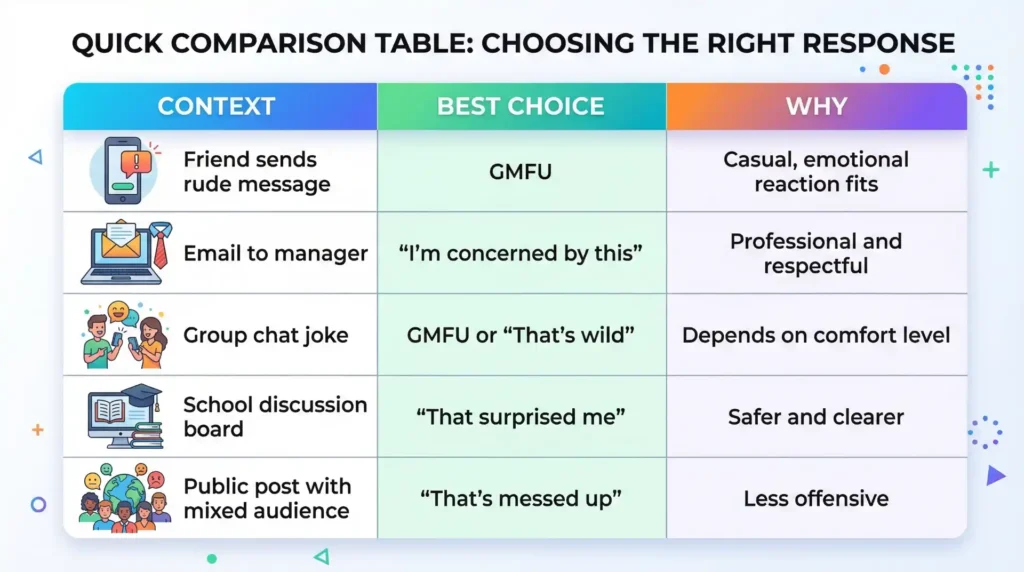
This is the key rule: match the tone to the audience.
Mini Quiz
1) What does GMFU usually stand for?
A. Give me full update
B. Got me fucked up
C. Go make fun updates
2) Is GMFU formal or informal?
A. Formal
B. Informal
3) Which feeling best matches GMFU?
A. Calm approval
B. Shock or frustration
C. Neutral description
4) Where is GMFU most appropriate?
A. Job interview email
B. Casual group chat
C. School essay
Answer Key
- B
- B
- B
- B
These answers match the dominant usage shown in current public sources.
FAQ
Does GMFU always mean something negative?
Usually yes, but the exact tone can vary. It often signals frustration or disbelief, though some people use it jokingly or with exaggeration.
Is GMFU the same as saying “you got me messed up”?
It is close in feeling, but GMFU is stronger and more vulgar. “Messed up” is the cleaner version.
Can I use GMFU with teachers or at work?
That is usually a bad idea. It is slang with profanity, so it can sound rude or unprofessional.
Do people say GMFU out loud?
Some do, but it is much more common in texts and online writing. People may also say the full phrase instead of the letters.
Is GMFU in the dictionary?
It appears in slang and acronym references, but it is not a standard formal vocabulary item in the way ordinary dictionary words are.
Conclusion
GMFU meaning in text is usually “got me fucked up.” It is a strong slang reaction used for shock, frustration, disbelief, or feeling disrespected.
The safest way to use it is in casual chats where people already use this kind of language. In professional or polite settings, choose a cleaner alternative instead. That simple choice will help you sound natural without sounding rude.